
Blackjack Calculators: Basic Strategy, Odds and House Edge
Nov 6, 2026
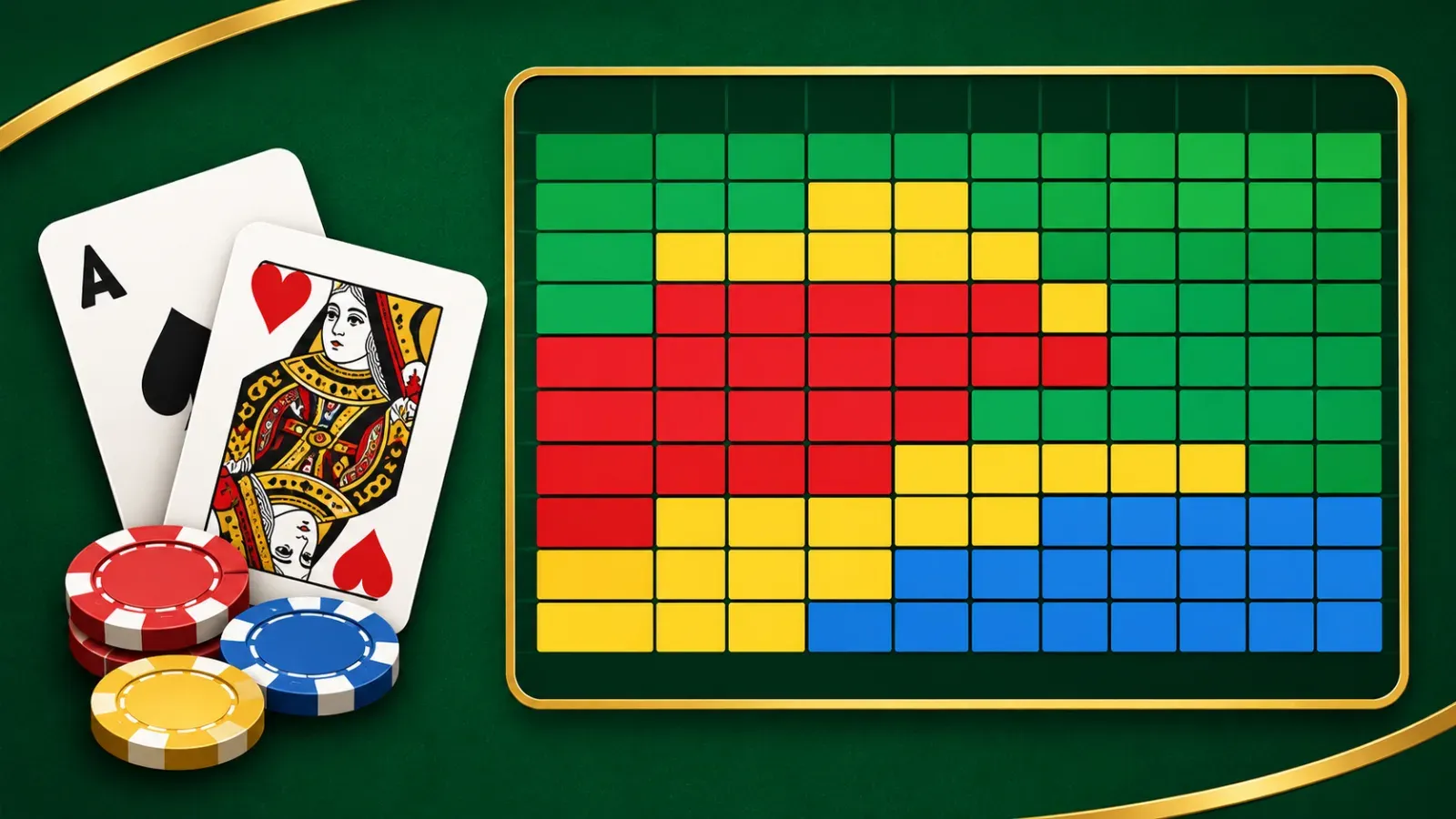
Blackjack Calculators is about the numbers behind blackjack. Every decision at the table has an expected value, and basic strategy is the starting point for making the right one.
Next, dive into blackjack odds and probabilities, the house edge and rule variations, card counting theory and bankroll and session planning.
Basic strategy is the mathematically best way to play every hand of blackjack, based on your cards and the dealer's upcard. It was worked out using computer simulations of millions of hands. Following it does not guarantee a win, but it reduces the house edge to the lowest level possible without counting cards. This page explains how it works.
What basic strategy does
In blackjack you make decisions: hit, stand, double down, split or surrender. For every combination of your hand and the dealer's upcard, one of these choices has the best expected result over the long run. Basic strategy simply lists those choices. Under typical rules, perfect basic strategy brings the house edge down to roughly half a percent. Playing on instinct usually costs a lot more.
How to read a strategy chart
A strategy chart is a grid. The rows show your hand, the columns show the dealer's upcard from 2 to ace. Each cell tells you what to do. Charts are usually split into three sections:
- Hard hands: hands without an ace, or where the ace must count as 1.
- Soft hands: hands with an ace counting as 11, such as ace-6.
- Pairs: whether to split.
Key decisions to remember
- Always split aces and eights.
- Never split tens or fives.
- Stand on hard 17 or higher.
- With hard 13 to 16, stand against a dealer 2 to 6 and hit against 7 to ace.
- With hard 12, stand against a dealer 4 to 6 and hit otherwise.
- Double down on 11 against most dealer upcards.
- Do not take insurance.
Why the dealer's upcard matters
The dealer must follow fixed rules, usually drawing until 17. When the dealer shows a weak card such as 5 or 6, there is a good chance they will bust. That is why basic strategy often tells you to stand on a weak hand and let the dealer take the risk. Read more about these probabilities on our page about blackjack odds.
Rules change the chart
Small rule differences, such as whether the dealer hits soft 17 or whether you may double after splitting, change some decisions. Always use a chart that matches the rules of the table. See how rules affect the game on our page about house edge and rule variations.
Responsible play
Basic strategy reduces the house edge, but the casino still has an advantage. Treat blackjack as paid entertainment, set a budget and stop when you reach it. Tips on budgeting are on our page about bankroll and session planning. Gambling is for adults (18+) only.
Hard totals, soft totals and pairs
A strategy chart is split into three parts. Hard totals are hands without an ace, or where the ace must count as 1. Soft totals contain an ace that can still count as 11, such as ace-six. Pairs are two cards of the same rank that you may split. Each section has its own rows, because the best play for a soft 17 is very different from a hard 17. Learning to recognise which section applies is the first step towards using a chart quickly.
A few examples
- Hard 16 against a dealer 10: hit, or surrender if allowed. Standing loses more often in the long run.
- Soft 18 against a dealer 9: hit. Many players stand here, but it is a weak total against a strong upcard.
- Pair of 8s: always split. Sixteen is the worst hard total, while two hands starting with 8 have far better prospects.
- Pair of 10s: never split. Twenty is already a very strong hand.
- Hard 11 against a dealer 2 to 10: double down where the rules allow.
Practising until it is automatic
Basic strategy only helps if you apply it consistently. Start with the hard totals, which cover most hands, then add soft totals and pairs. Use flashcards or a practice tool, and check your decisions against the chart until you rarely need to look. Most players find that a few short practice sessions are enough to remember the key rows. Printable versions are in blackjack basic strategy charts.
What basic strategy cannot do
Even perfect basic strategy leaves the house with a small edge, typically around half a percent on good rules. You will still have losing sessions, sometimes long ones. The value of the strategy is that it keeps the cost of playing as low as possible. To see how much rules matter, read house edge and rule variations.
Combine the chart with an understanding of blackjack odds and probabilities and you will know not only what to do, but why it works.
Learn it once, and it will serve you at every table you play.
Frequently asked questions
Does basic strategy guarantee a win?
No. It gives the best result over the long run, but the casino keeps a small edge and short sessions can go either way.
Can I use a strategy chart at the table?
In most online games you can keep a chart next to you. In land-based casinos it is often tolerated, but check the house rules.
Should I ever take insurance?
Basic strategy says no. Insurance has a high house edge for players who do not count cards.